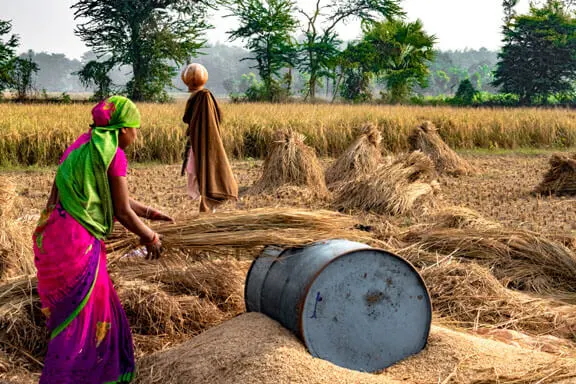
Agriculture is the backbone of Pakistan. Ever since Pakistan’s Independence, agriculture was supposed to be the main source of revenue for the government. However, Pakistan’s agricultural sector has been seeing a lot of ups and downs during the past few years. With an agro-based economy, Pakistan hasn’t been benefiting from the Agricultural sector as it should have. Our exports have dropped over the years and as the backbone of the country weakens, it’s difficult for the government to focus on infrastructure.
The government collects taxes and uses them for the welfare of its citizens. However, people of Pakistan have long been ambiguous about the taxation policies of the agricultural sector. The government of Pakistan ensured that people in the agricultural occupations are not burdened with backbreaking taxes as they’re usually not from strong backgrounds and hence choose the farming side. Let’s look at the Agricultural tax in Punjab, Pakistan.
Taxes on Agricultural Sector and GDP of Punjab, Pakistan in 2023
In 2022, the agricultural sector of Pakistan added an astonishing amount of Rs 11.5 trillion to the GDP of Pakistan. However, even with that immense contribution, the profit made by the government was on Rs 3 billion. This amounted to a tiny proportion of 0.002% in the GDP of Pakistan in 2022. However, the government collected an immense Rs 1.7 trillion from the other sectors.
This amounts to a feeble 5% in the GDP. Experts suggest that if the government had taken the same amount of Income tax from the agricultural sector, the total amount would’ve been something near Rs 575 billion. This would’ve been almost 200 times higher than the current amount collected.
However, the other side of the coin suggests that Pakistan’s Constitution has clearly stated that the taxes on the agricultural sector have to be minimum as the people contributing to this sector are usually not from well-off families and they’re not knowledgeable enough to know about the taxation policies as well. Therefore, the government suggested that agricultural taxes be implemented on the provincial level only and must be kept minimal.
Agricultural tax According to the (ITO) Income Tax Ordinance 2001 for Punjab Pakistan in 2023
The Income Tax Ordinance of 2001 has been dictating the taxes on the agricultural sector. It was introduced in 2001 and was drafted by Gen. Pervaiz Musharraf.
According to the ITO of 2001, a person who generates his income from the agricultural sector does not need to pay taxes to the federal government. However, this doesn’t mean that they’re totally exempted from paying taxes, they still have to pay taxes to the provincial government.
This ITO of 2001 was introduced to ensure equality and justice for all. This is because all provinces are not the same as the land of Punjab is more fertile while Balochistan is mostly a desert area. This law ensured that the taxpayers would be answerable to their provincial governments and not the federal government.
Income Tax Act 1997 for Punjab, Pakistan in 2023
The Punjab Income Tax Act (ITA – 1997) was introduced by Nawaz Sharif during his government in 1997. All other provincial taxation laws are also similar to this act with some amendments.
The ITA-1997 clarifies which income is agricultural income and which income is not derived from agriculture. This act states that agricultural tax should be paid every year and an assessment will take place every year. The assessment is to start on the 1st of July and end on 31st of June next year. This act stated that there will be two types of taxes. The first type will be based on land i.e. Land-based tax while the other will be Income-based i.e. the tax based on agricultural income.
Land-based tax by Income Tax Act of 1997 in Punjab, Pakistan 2023
According to ITA-1997 the amount of tax will depend on the land cultivated or irrigated. The tax will be collected on the acres of land being cultivated. However, the notable thing here is that the amount of tax for cultivated land is 50% of the irrigated land. In simple words, the tax collected on the unirrigated land would be half the tax collected on irrigated land.
According to this Act, there is no tax if the cultivated land is less than 12.5 acres. However, if the land is more than 12.5 acres but is less than 25 acres, the tax imposed on such land would be Rs 300. Similarly the Act states that if the land exceeds 25 acres but is less than 50 acres, the tax imposed on such land would be Rs 400. Lastly, if the land being cultivated is more than 50 acres then the tax imposed on this land would be Rs 500 Rs. Moreover, there would be a tax of Rs 600 at the time of maturation of orchards.
Agricultural Income tax in Punjab, Pakistan in 2023 According Income Tax Act 1997
The calculation of the income tax imposed by this Act is a bit complex. The FBR calculates the agricultural income tax. According to the Income Tax Act 1997, if the income generated by agriculture is not more than Rs 400,000 or 4 lacs, then no tax would be imposed. However, if the income is more than Rs 400,000 or 4 lacs but is less than Rs 800,000 or 8 lacs, the tax imposed would be Rs 1,000. Moreover, if the income is more than Rs 800,000 or 8 lacs but less than Rs 1,200,000 or 12 lacs, the tax imposed will be Rs 2,000.
Similarly, if the income generated is more than Rs 1,200,000 or 12 lacs but less than Rs 2,500,000 or 25 lacs, there will be a 5% payable tax on the amount that is exceeding Rs 1,200,000 or 12 lacs. However, if the income is more than 24 lacs but less than 48 lacs, then the tax imposed would be Rs 60,000 plus 10% of the amount that is more than 24 lacs.
Lastly, if the income generated by agriculture is more than Rs 4,800,000 or 48 lacs, then you are liable to pay Rs 300,000 as tax upon 48 lacs and 15% on the amount that exceeds 48 lacs.
Collection and Assessment of Taxes
It is a common misconception that FBR collects the taxes after assessment. However, in reality, the taxes are collected by the District Collector that is assigned under the Act Punjab Revenue of 1967. The Agricultural Income Tax in Punjab, Pakistan in 2023 is mainly directed by the Tax act of 1997 and of 2001. If an individual owns land in more than one district or province, they are to notify the FBR so they can be assessed and pay their due taxes to the government.
There had also been another misconception about the increase in agricultural taxes in Punjab. Read more here Fact Check: Have Agricultural Taxes Actually Increased in Punjab?

![Honda CD 70 Latest Price in Pakistan [January 2024 Update]](https://sstoday.com.pk/wp-content/uploads/2024/01/Honda-70-Price-120x86.webp)
![Honda 125 2024 Latest Price in Pakistan [January 2024 Update]](https://sstoday.com.pk/wp-content/uploads/2024/01/Honda-125-120x86.webp)