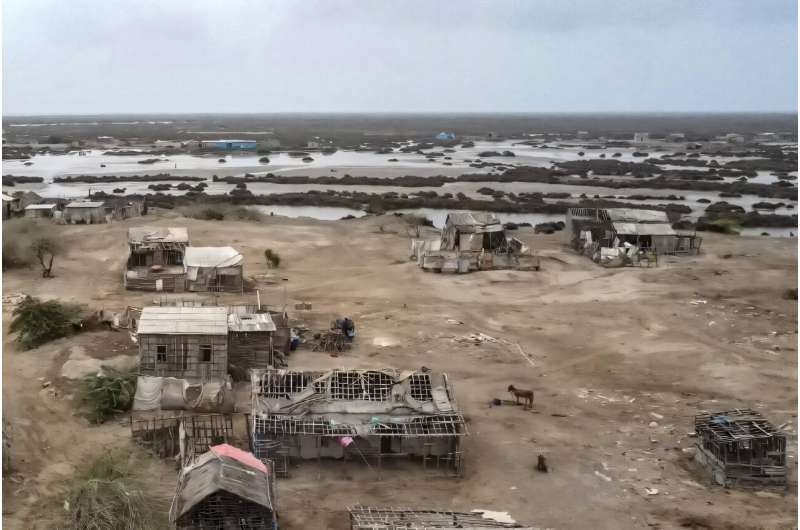
Salt crusts crackle beneath Habibullah Khatti’s feet as he walks to his mother’s grave to say a final goodbye before leaving his dried-up island village in the Indus Delta.
Seawater intrusion in the Indus Delta, where the Indus River meets the Arabian Sea, has destroyed farming and fishing communities, forcing thousands of people to leave their homes. In Kharo Chan town, seawater has swallowed most of the 40 villages. The population dropped from 26000 in 1981 to only 11,000 in 2023. Now, many families are migrating to Karachi in search of survival.
According to the Pakistan Fisherfolk Forum, tens of thousands of people have already been displaced from the delta’s coastal districts. A recent study by the Jinnah Institute reported that over 1.2 million people have left the Indus Delta in the last 20 years. The main cause of this crisis is the reduced freshwater flow due to irrigation canals, dams, and climate change. Since the 1950s, the water flow into the delta has dropped by 80%. As a result, seawater has moved inland, increasing salinity by 70% since 1990. This has made agriculture impossible and damaged fish and shrimp stocks.
More than 16% of fertile land in the delta has become unproductive. In areas like Keti Bandar, salt covers the ground and drinking water must be brought in by boats or donkeys. To restore the delta, the government and UN launched the Living Indus Initiative. Sindh government is also planting mangroves to stop seawater from entering more land.
Despite some recovery efforts, ongoing land grabbing, population pressure, and India’s threat to cut off Indus water supplies continue to put the region at risk. Families say they are not just losing homes but also their culture and way of life.

![Honda CD 70 Latest Price in Pakistan [January 2024 Update]](https://sstoday.com.pk/wp-content/uploads/2024/01/Honda-70-Price-120x86.webp)
![Honda 125 2024 Latest Price in Pakistan [January 2024 Update]](https://sstoday.com.pk/wp-content/uploads/2024/01/Honda-125-120x86.webp)